
May 12, 2020





Decoupled Drupal is one of the most oversimplified decisions in enterprise web architecture. Agencies push it as the modern default. Internal teams resist it as unnecessary complexity. The honest answer is that it depends entirely on what you're building and who needs to operate it after launch.
In a traditional Drupal setup, the CMS handles everything: content management, business logic, and front-end rendering. In a decoupled architecture, Drupal manages content and serves it via API, while a separate front-end framework, such as React, Next.js, or Vue, handles the presentation layer.
Each model carries different trade-offs in cost, complexity, editorial experience, and long-term maintenance.
Curious where your platform stands? Take the free AI-Readiness Scorecard →
If your Drupal instance needs to feed a website, a mobile app, in-store displays, and partner portals from a single content hub, decoupling is the right answer. Drupal's mature JSON:API and GraphQL support make it a strong content engine for this scenario.
Highly interactive applications, real-time dashboards, complex data visualizations, and single-page app experiences benefit from dedicated JavaScript frameworks that Twig templates weren't designed to support.
A decoupled architecture entails two codebases, two deployment pipelines, and a team that maintains both PHP/Drupal and JavaScript over the long term. If that capacity exists and is funded, decoupling is viable. If it doesn't, the architecture becomes a liability within 18 months.
For marketing sites, institutional portals, and content-heavy platforms, most enterprise Drupal use cases do not require a separate front-end framework. Traditional Drupal handles these with lower build cost, simpler maintenance, and a better editorial experience.
Decoupled architectures create a dependency between content teams and developers. Changing a layout or adding a content type to the front end becomes a developer ticket, not a drag-and-drop action.
Decoupled projects cost more to build, more to maintain (separate security patches, coordinated deployments), and more to staff. If the use case doesn't demand it, that investment doesn't pay back.
This is where the 2026 landscape shifts the equation. Drupal CMS 2.0, released January 2026, introduces Drupal Canvas as the default editing experience, a visual, drag-and-drop page builder with live preview, real-time editing, and a component library that includes cards, heroes, testimonials, accordions, and more.
Canvas directly addresses the editorial experience gap that has historically been the strongest argument for decoupling. Teams that previously needed a React front end to deliver modern, flexible page layouts can now achieve comparable results within Drupal's native interface without a second codebase.
Critically, Canvas also supports React-based code components. Developers can build custom interactive elements that work within the visual builder progressive decoupling in practice, without the overhead of a fully separate front end.
For many organizations evaluating architecture in 2026, Canvas changes the answer from "yes, decouple" to "we can get what we need without the overhead." For organizations that need enterprise-grade workflows, security, and governance on top of Drupal CMS 2.0, Varbase adds those configurations out of the box without diverging from Drupal's official roadmap.
The decision comes down to three questions. If you answer "no" to all three, decoupled architecture adds cost and complexity without proportional return, and Drupal CMS 2.0 with Canvas likely covers what you need.
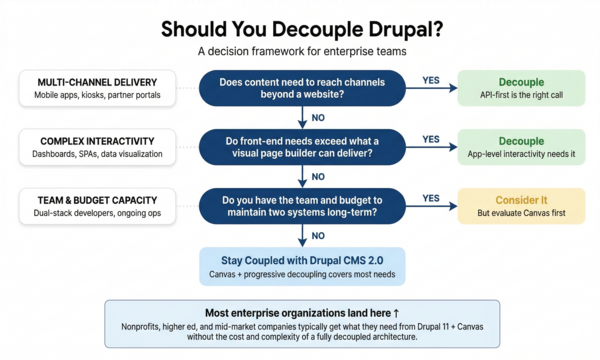
Decoupled Drupal is a powerful architecture for the right use case. It is not the default answer for modern web development. The arrival of Drupal CMS 2.0 and Canvas narrows the gap further, giving editorial teams visual building capabilities that previously required a separate front end.
At Vardot, we architect both coupled and decoupled Drupal implementations. The recommendation depends on the use case, not the trend. If you're evaluating architecture options as part of a Drupal migration or modernization initiative, we can help you assess which approach fits.
Decoupled Drupal (also called headless Drupal) separates content management from presentation. Drupal manages content and delivers it via API, while a separate front-end framework like React, Next.js, or Vue handles the display layer. Unlike traditional Drupal, which handles both, decoupled architecture splits these into two distinct systems.
Choose decoupled Drupal when you need to deliver content to multiple channels (website, mobile apps, displays, portals), require highly interactive experiences like real-time dashboards or complex visualizations, and have a dedicated team with budget to maintain both PHP/Drupal and JavaScript codebases long-term.
Drupal CMS 2.0's Canvas is a visual drag-and-drop page builder that addresses the editorial experience gap that previously drove teams to decouple. Teams can now create modern, flexible layouts within Drupal without a separate front-end codebase. Canvas also supports React-based custom components for progressive decoupling when needed.
Yes, significantly more. You're building and maintaining two systems instead of one: higher development costs, dual security patching, coordinated deployments, and staffing for both backend (PHP/Drupal) and frontend (JavaScript) expertise. Unless your use case specifically demands decoupling's capabilities, the additional investment doesn't deliver proportional return.

